
Things to Do in Jaipur in Monsoon: Forts, Cafes and the Aravallis After Rain

Rajasthan is sold to the world in dry-season colours: ochre, dust, and a hard blue sky. It is a fair portrait for eight months of the year, and an incomplete one. For a few weeks between July and September the rain arrives, and Jaipur becomes a quieter, greener and altogether more romantic version of itself.
The forts stand beneath moving cloud rather than flat glare. The lakes fill. The Aravallis, brown and patient for most of the year, turn an improbable green. And the city empties of the queues that define its winter season, which may be the least discussed luxury of all.
Understanding the Season
The monsoon reaches Jaipur in late June or early July and lingers into September. It rarely rains for a whole day. The rhythm is one of heavy, theatrical bursts, most often in the late afternoon or overnight, separated by long and generous clear spells.
Temperatures settle between the high twenties and mid thirties Celsius, a considerable mercy after the pre-monsoon heat. The practical consequence is that sightseeing remains entirely possible. One simply plans around the sky rather than the clock, and keeps the early mornings free, because the light over the city after a night of rain is the finest of the year.
Where to Go When It Rains
Nahargarh Fort
If the monsoon permits only one excursion, let it be this one. Nahargarh occupies the ridge above Jaipur, and in the rains the cloud gathers below the ramparts rather than above them. To stand on the walls and watch the city appear and disappear beneath drifting grey is among the defining sights of Rajasthan. Arrive in the late afternoon and stay for the light.

Amer Fort
Amer is formidable in any season, but wet sandstone transforms it. The stone deepens in colour, the hills behind soften from brown to green, and Maota Lake below holds water as its builders intended. Arrive early, ahead of both the coaches and the afternoon rain.

Jal Mahal
The water palace on Man Sagar Lake was conceived for precisely this season. Through much of the year the lake sits low and the building appears marooned. In the rains it settles properly into the water and the reflection returns. There is no entry, but the view from the Amer road costs nothing and asks ten minutes.

Galta Ji
The temple complex set into the hills east of the city, known to most visitors as the Monkey Temple, is fed by natural springs that come alive after rain. A short walk leads up through the pass, and in monsoon the surrounding hillside is green rather than scrub. Sensible shoes are advised; the stone becomes genuinely slick.
Sisodia Rani Ka Bagh
A tiered Mughal-style garden on the Agra road, and one of the few places in Jaipur built expressly around water channels and fountains. In the dry months it can feel a little wistful. In the rains it finally reads as intended.
Kanota Dam
East of the city, Kanota Dam fills during a strong monsoon and becomes a favoured local excursion. Conditions vary considerably from year to year, and access is sometimes restricted when levels run high, so it is worth checking locally before committing to the drive. The broader principle holds regardless: in monsoon, almost any road out of Jaipur rewards more than the road in.
Where to Wait Out the Rain
Monsoon travel requires somewhere civilised to sit while a downpour passes. Jaipur is unusually well provided for.

Curious Life Coffee Roasters
In C-Scheme, and the most serious coffee in the city. They roast in house and brew to order. Small, quiet, and ideal for an unhurried hour with a book while the weather settles.
Tapri Central
A Jaipur institution. The rooftop is the reason to come, and the covered sections remain usable through the rains while you watch it fall over Central Park. Chai is the obvious order, though the kitchen deserves attention too.
Bar Palladio
Housed within the Narain Niwas Palace hotel, and quite unlike anywhere else in Rajasthan: cobalt blue, theatrical, with an Italian menu. It is an indulgence, and worth committing to at least once. The garden is at its best on a clear evening between showers.
Anokhi Cafe
Adjoining the Anokhi store in C-Scheme. Organic salads, excellent bread, proper coffee and a calm room. A useful refuge if you are shopping nearby and the sky turns.
Menus and hours change with the season, so it is worth confirming before making a particular journey.
The Case for Staying Outside the City
There is a reasonable argument that monsoon is the wrong season to base yourself in the centre of Jaipur. The old city is congested, drainage is inconsistent, and the thing that has genuinely improved lies beyond the ring road, in the hills.
Kankas House sits in the forested Aravalli foothills off Delhi Road, roughly an hour from the centre. It is a private four-bedroom villa sleeping up to ten, with a private pool, open lawns, and a bonfire and barbecue setting for the evenings. In the rains the surrounding hills are green, the air is washed clean, and the view from the lawn becomes the reason to be there rather than in a hotel corridor.
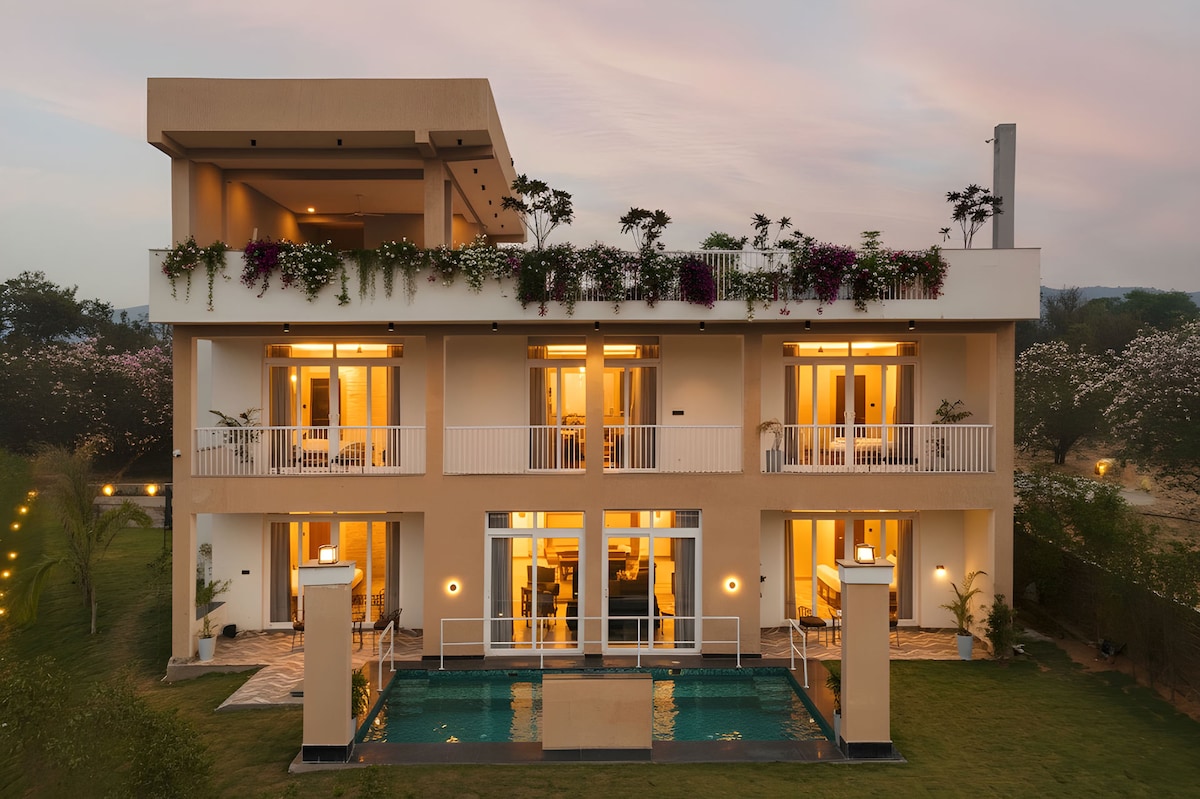
A chef cooks on site, which matters rather more than it sounds once the rain closes in and the prospect of driving back into town for dinner loses its charm. In practice the pattern that works is a single day of forts and cafes in the city, and the remainder at the villa.
For families, we have written separately on family getaways near Jaipur. For a birthday or an anniversary, the lawns accommodate thirty to fifty guests for the day: celebrations in Jaipur.
Practical Notes
- Footwear with grip. Fort steps and temple stone are treacherous when wet.
- A light rain shell rather than an umbrella. The wind along the ridges makes umbrellas ornamental.
- A dry pouch for a camera or phone.
- Repellent, particularly if you are staying beyond the city.
- Slack in the itinerary. A two-hour downpour will happen. Plan around it rather than against it.
Is Monsoon a Good Time to Visit Jaipur?
Yes, with a single caveat. If the trip depends on completing a fixed list of monuments to a fixed schedule, the rain will frustrate it. If you would rather have the Aravallis green, the lakes full, the forts under real weather, fewer people in every photograph and considerably better rates, then monsoon is the most underrated season in Rajasthan.
The trick is not to resist it. Choose somewhere you are content to sit still in, hold the sightseeing loosely, and let the weather set the pace.
Discover Kankas House, or enquire directly for monsoon dates.